The idea in one sentence
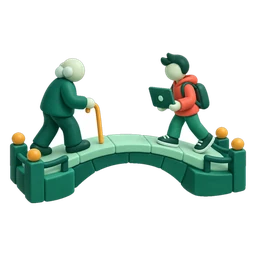
We build pairs of experienced retirees and young people at the start of their careers: the retiree mentors the young person professionally and the young person teaches the retiree digital skills, so both gain and the social fabric grows stronger.
The problem
An ageing society without protection
Lebanon is one of the fastest-ageing countries in the Arab region: people over 65 make up about 11% of the population and are expected to reach 23.3% by 2050, while only 9.8% of older people received a pension in 2020.
Isolation and a digital divide
With their children emigrating and services going digital, older people face growing isolation and difficulty communicating and completing their paperwork.
Lost expertise
Meanwhile youth unemployment is 47.8%, and society loses accumulated professional expertise that is not passed on to the next generation.
Sources: ESCWA via Al-Monitor (2021); UNFPA, Country Profile on Older Persons (2022); Labour Force Survey, Central Administration of Statistics and ILO (2022)
Target groups
- Retirees over 60 with expertise (teachers, engineers, craftspeople, administrators).
- Young people aged 18 to 30 looking for career guidance.
- Older adults who need basic digital skills.
Methodology
- 1
Phase 1 — Expertise bank
Mapping retirees and their fields of expertise, and young people and their needs, then matching pairs by field and area.
- 2
Phase 2 — Mutual mentoring
A weekly meeting for 3 months: one hour of career mentoring and one hour of digital teaching (phone, contact with children abroad, banking apps, e-government transactions).
- 3
Phase 3 — The joint project
Each pair produces a joint piece of work, such as documenting a craft, a career guide or an illustrated story, shown at the annual “Generations Day”.
Success factors
Very low cost
The main resource is people and their time, not equipment.
Supportive social values
Lebanese society values its elders, which eases acceptance and participation.
A ready network
The Foundation's volunteer teams and partner youth associations provide the young people and the organisation.
Targets and impact indicators
- 30Retiree mentors
- 90Young people receiving mentoring
- 120Older adults learning digital skills
- 30Documented joint works
- 30%Reduction in feeling isolated (before/after survey)
- 50%Pairs that continue after the programme
All figures on project cards are targets, not achieved results, unless stated otherwise.
Challenges and how we address them
| Older adults' difficulty travelling | Meetings close to home, and home visits when needed. |
|---|
| A trust gap between generations | An introductory session and a mutual-respect charter at the start of each pair. |
|---|
| Sustaining the relationship | A monthly Generations Club after the programme keeps the network alive. |
|---|
Lessons the project is built on
- Older people are not only a group to be cared for; they are a knowledge resource society can invest in.
- A reciprocal relationship, where each side gives and receives, preserves dignity better than one-way help.
- Our advice: start with a few successful pairs; their stories are the strongest tool to attract participants.
Why it deserves to be showcased
An original idea
It addresses two opposite problems, isolated ageing and young people without guidance, with one solution.
Transferable
Ageing is a global phenomenon, and the model needs only volunteers and organisation.
Inspiring
The pairs' stories touch people and are well suited to showcasing.
Sustainable Development Goals
Goal 3 for well-being and reduced isolation; Goal 4 for digital skills; Goal 8 for career guidance; Goal 10 for inclusion across generations.